
Day 11: Kyiv
Stop Stealing the Future: Chronicles of the Ukrainian Resistance

“Stop Stealing the Future: Chronicles of the Ukrainian Resistance” is a series of interviews and field observations recorded during travels across Ukraine during the Russian invasion.
A Journalist in Exile
Hromadske Radio’s Viktoria Yermolaeva on fleeing Crimea and defending Ukraine’s free press
I met Viktoria Yermolaeva at Паштет (Pashtet Café), a cozy Kyiv spot whose name—literally pâté or spread—captures the warmth and humor of the city’s café culture. Known for traditional Ukrainian dishes and informal gatherings, its secluded second floor was a stylish, quiet place for a conversation.
Viktoria works with Hromadske Radio, one of Ukraine’s leading independent nonprofit media outlets, producing news, interviews, and podcasts focused on politics, society, and the war.
Thanks to Roman Kifliuk for his introductions to Viktoria and numerous other Ukrainian media executives, journalists, and entrepreneurs. Roman is national advisor for Ukraine at IMS (International Media Support), a non-profit organization working to support journalists and media in countries affected by armed conflict, human insecurity, and political transition.
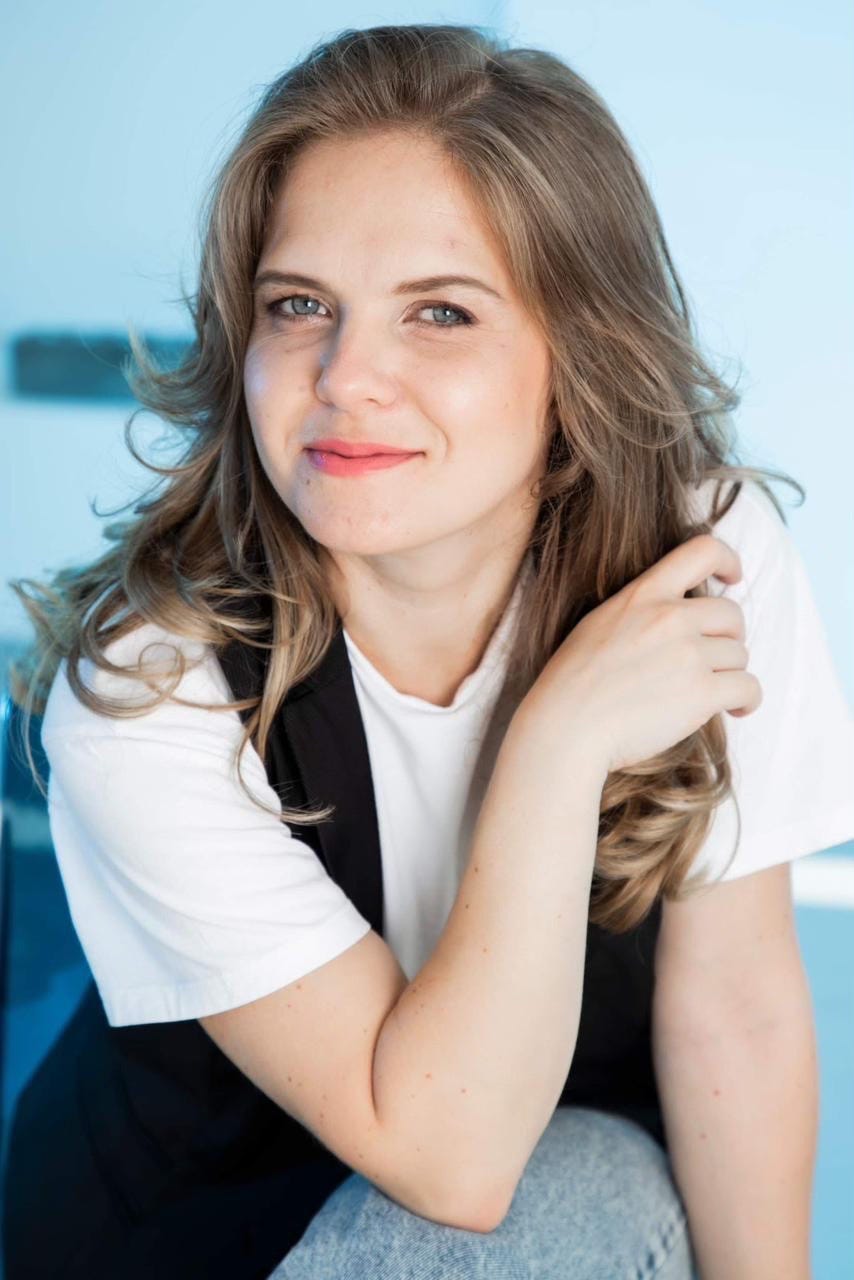
Viktoria: I’m the editor-in-chief of Hromadske Radio, an independent media outlet. I moved to Kyiv from Crimea in 2014, when Russia occupied my city. It was a very difficult decision, because I had to leave my home and my past behind. I left with a small suitcase and about 4,000 hryvnias (roughly US$95 at the time). It wasn’t enough, but I knew I couldn’t live under the Russian flag.
Brian: Was this right after the Russian takeover?
Viktoria: I was already in Kyiv during the 2013 Euromaidan protests. I was writing about what was happening there, and when I returned to Crimea, I was persecuted for my pro-Ukrainian activities. Russian forces and their local supporters were targeting journalists and activists. I received threats — messages saying, “We know where you live; we’ll find you.” They were shutting down independent media and trying to silence everyone with pro-Ukrainian views.
Brian: Did you experience direct danger?
Viktoria: Yes. When I called the local police, they didn’t protect us. It was clear Russia had already prepared the ground — local officials, deputies, police — many were bribed or threatened to support the occupation. It became too risky to stay.
Brian: Was the persecution because you joined the Euromaidan movement or because you were a journalist?
Viktoria: Both. Russia’s strategy was to remove pro-Ukrainian people and replace them with their own agents — people who looked like ordinary citizens but served Russian interests. The so-called “referendum” showing over 95% support for joining Russia was fake. Most Crimeans were passive; they stayed home, watched television, and waited to see what would happen.
Brian: What’s your estimate — how many Crimeans supported or opposed the occupation?
Viktoria: Maybe 10% welcomed Russia, 30% opposed it, and 60% didn’t care or didn’t understand what the change would mean or were simply afraid.
Brian: Why does Russia target journalists and media first when occupying new areas?
Viktoria: Because independent media are a threat to control. The first thing Russia does is block radio and TV signals and replace them with Russian propaganda. That’s what happened in Crimea, and the same now happens in occupied parts of Donetsk or Kherson.
“Free information is dangerous to authoritarian power.”
Brian: What kind of journalism were you doing back then, and what do you do now?
Viktoria: In 2013–2014, I worked for an independent outlet in Kerch (Crimea). There was no censorship; I could report the truth and expose Russian propaganda. Now, as editor-in-chief, I lead a team that continues that mission — to provide independent, fact-based reporting even during war.
Brian: What did the Euromaidan (the 2013/ 2014 nationwide protests) mean to you personally?
Viktoria: I was 23. I was young and full of hope. The protests inspired me — professors, workers, students, people from every walk of life were standing together. It was a powerful and unique moment for Ukraine.
Brian: Some sociologists say that when people see others taking risks — especially young people — it motivates them to join. Was that your experience?
Viktoria: Yes. Seeing people’s courage gave others courage. Euromaidan united Ukrainians in a way we’d never seen before.
Brian: Now, as a journalist and citizen, why do you continue to resist? Why is it so important for Ukraine to remain independent from Russia?
Viktoria: Because of everything we’ve lost. I lost friends, my home, and people tried to humiliate me for believing in Ukraine. Russia must be stopped. The pain and suffering of the last eleven years are indescribable. Even with little money, we keep our media alive, even near the front lines. We’ve saved lives — people listen to us for evacuation routes or safe roads. Independent media are not just information; they are protection.
Brian: How do you feel when world leaders, like Donald Trump or others, talk about giving away Ukrainian territory?
Viktoria: It feels like betrayal — a humiliation for all Ukrainians and Europeans who are fighting and dying for freedom. When Western leaders say “we don’t need you,” it’s as if they erase our sacrifice.
Brian: Finally, what’s the difference between life in Ukraine and life under Russian control — in Crimea or Moscow — especially regarding freedom and journalism?
Viktoria: In Ukraine, we are free to tell the truth, to protest, to criticize the government. There’s no censorship. In Russia, the state destroys independent media, the Ukrainian language, and culture. They want to erase our identity. But we will not surrender.
A Bucha Survivor
Forty-Four Days of Torture in Russian Captivity
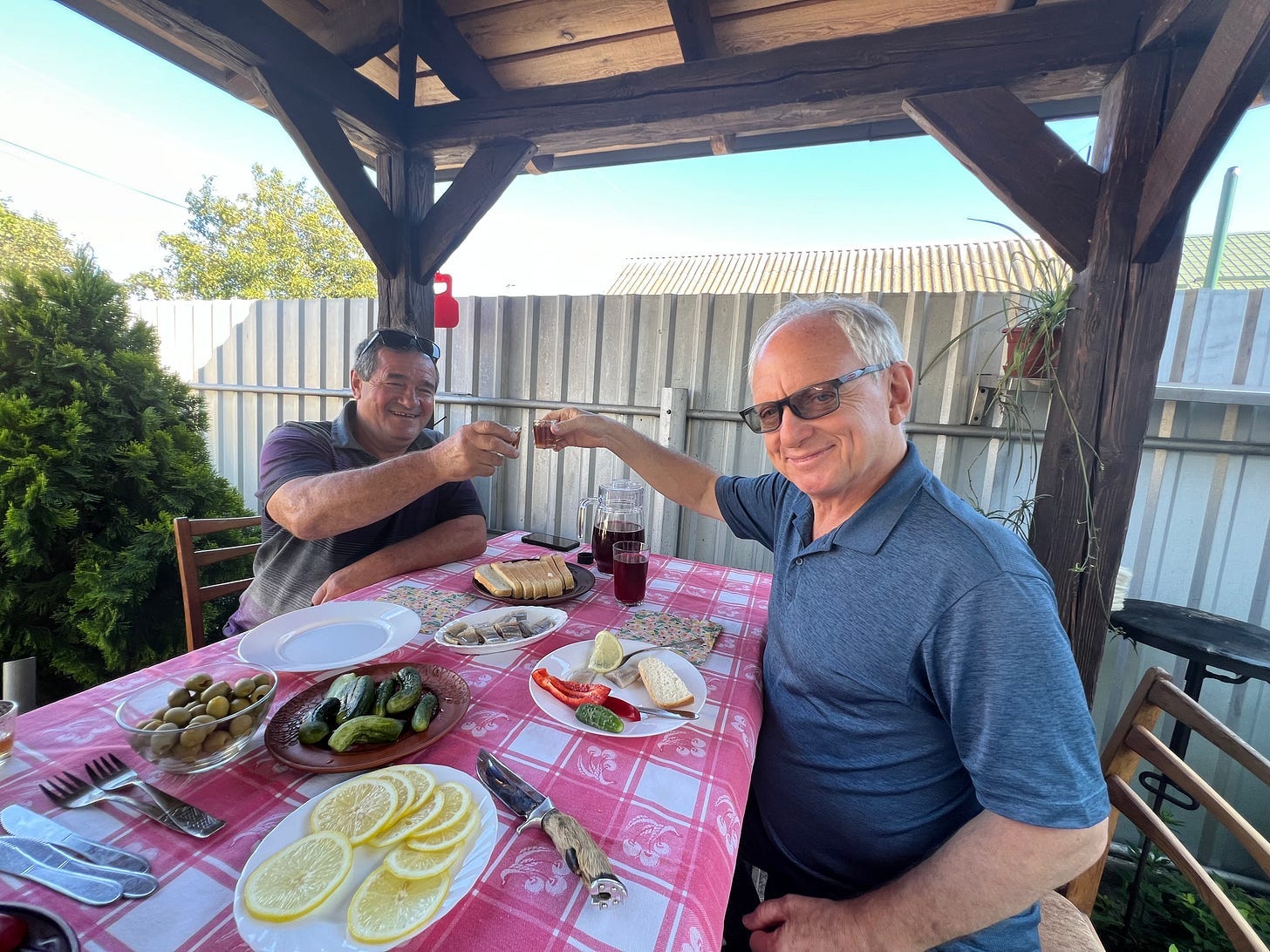
Sasha sits across from me on the outdoor patio of his Bucha home, relaxed, buoyant, as he begins to describe what happened to him during the Russian occupation.
For the next hour, with the help of interpreter Vasylyna Shvets, he shares the brutal details of his detention—a 44-day stretch of torture, of beatings, cold, and confinement with a composure that defies the intensity of his story.
In March 2022, Russian forces occupied Bucha, a suburb of Kyiv, where hundreds of civilians were killed during weeks of control before Ukrainian forces retook the area. The discoveries that followed—mass graves, execution sites—would come to define the brutality of the invasion’s early days.
Elena Chebotayeva, Sasha’s neighbor, had warned me in advance: he would insist that we stay for dinner.
I had already promised Alex, a Kyiv-based attorney who was driving Vasylyna and me around town that day, that we would leave early to beat the Friday rush hour traffic, with time to stop at the Babyn Yar memorial.
When the interview ended, I explained that we need to go.
Sasha pauses, then asks if we might stay for dinner.
I apologize and tell him we really don’t have time. He nods, but the disappointment is visible—the first sign of anguish I’ve seen all afternoon.
Then, gently, he offers an alternative.
At least one drink.
We agree.
He disappears into the house and returns with a colossal sealed bottle of Jack Daniel’s, clearly saved for a special occasion.
The first pour is generous. The second arrives quickly. By the third, I thank him and begin to rise, explaining again that we have to go.
He looks at us and asks if we might stay for dinner after all.
This time, the disappointment is palpable.
I glance at Alex and Vasylyna. They smile and nod.
Sasha brightens immediately.
He leads us through the house, showing us shelves of homemade pickles and bottles of his own concoctions, before returning us to the table, where the meal begins to take shape—sausages, herring, dried fruits, dishes arriving one after another.
Only later do I fully register the contrast: a man who can recount forty-four days of torture without raising his voice, yet shattered by the thought that a guest might leave his home unfed.
The food is excellent. We will be late.
But disrespecting Sasha is not in the cards.
The Interview
Brian: First of all, Sasha, tell me where we are right now. Help me understand this neighborhood and this area.
Sasha: We are in the Bucha region, in my village. When the Russian invasion began, their soldiers came into this area with tanks and military vehicles. Many people hid in basements and shelters. I was in a shelter at first, but I decided to leave.
When I came out, I met Russian soldiers. They even asked me for a cigarette. I asked them why they had come to Ukraine—why they had invaded.
They told me they had come to “set people free.” I asked them, “Free from what?” They had no answer.
Brian: You had a military background, correct? You served in the Soviet military?
Sasha: Yes. I served in the Soviet army. I was trained and prepared to go to Afghanistan, but in the end I never went there. Instead, I was stationed in Kazakhstan.
Brian: Did you tell the Russian soldiers that you had served in the Soviet military? Did that make any difference?
Sasha: Yes, I told them. They were pleased to hear it. I think that fact probably saved my life.
I am also comfortable speaking Russian, which helped me later when I was imprisoned. When prisoners spoke Ukrainian, guards often beat them with batons or used stun guns. Speaking Russian sometimes protected me.
Brian: Was it shocking or confusing for you to see Russian soldiers attacking your neighborhood, considering you once served in the same army?
Sasha: Yes, it was extremely shocking.
I have twenty-one relatives in Russia. My father had eight brothers and sisters, so our family is very large and spread across many cities.
Before the invasion we were still communicating. Just a day or two before the invasion we spoke. I am openly pro-Ukrainian, but some of my relatives are not.
My brothers say they are Russian—even though they were born in Ukraine, even though they have a Ukrainian surname. Still, they say they are Russian.
My grandfather was a soldier. He was also a prisoner of war. And he always told us: Russians are liars. You cannot trust them.
When we watched war movies—especially films about Stalin—he would say, “This is all lies. It’s garbage. Don’t watch it.”
In Russia, they have Victory Day parades every year. My relatives take part in those parades. They carry photos of my grandfather as if he were part of their story.
But this goes completely against his will—against everything he believed.
One of my brothers sent me a message calling me a fascist. Russian soldiers later saw that message when they searched my phone.
Brian: Your relatives in Russia—do they believe what happened to you?
Sasha: No. They do not believe that I was taken prisoner or tortured. Even after I returned and told them what happened, they refused to believe it. I sent them videos showing the destruction here in Ukraine. They still did not believe me.
This is the result of propaganda. The propaganda in Russia today may even be stronger than during the Soviet period.
There is a joke: if the government says something white is actually red, then people must say it is red.
Brian: Is the situation today under Putin similar to that Soviet mentality?
Sasha: Yes, the approach is very similar.
If the government says something is true, people must repeat it. But in my opinion the Soviet system was sometimes more sophisticated. Today many people are simply fooled by propaganda.
The Invasion
Brian: Tell me more about what it was like here when the invasion began.
Sasha: When Russian troops occupied the village, I tried to speak with them peacefully. Later, officers noticed what I was wearing. I had blue and yellow sports clothes with stripes like the Ukrainian flag. I also had a coat with a trident symbol—it had belonged to my father.
The soldiers ordered me to stop and demanded my phone. When they searched it, they saw the message from my brother calling me a fascist.
Because of that message, they arrested me.
They put me into an infantry fighting vehicle. We drove for four days. Prisoners were packed so tightly that we were like mattresses for each other inside the vehicle.
Eventually we were taken first to Belarus and then transported to Russia—to the Kursk region.
Brian: What were you thinking while this was happening?
Sasha: I was captured together with a man I knew. During the transport I said to the others: “Who knows? Maybe on May 9 they will parade us in Red Square for Victory Day.”
I believed I would become a prisoner of war.
I also think the Russian officers already knew about me. I helped build checkpoints in the village and tried to defend the area. I also participated in the Maidan protests.
One officer said the word “Maidan” when they arrested me. So they likely already knew who I was.
In Russian Captivity
“We were beaten for up to six hours a day.”
Brian: Tell me about your captivity in Russia.
Sasha: It was winter—about minus fifteen degrees.
There were about twenty-five tents where prisoners were held. Russian propaganda reporters were there filming everything for television. They even brought people who appeared to be from the Red Cross, but it was staged for propaganda.
We had to kneel on the snow for two hours. We could walk only on our hands and knees.
Later, after the interview, Sasha told me that he was chained outside in the snow, naked, for hours.
There was almost no food or water. We were not allowed to go to the toilet. Once they gave us food, but it was boiling hot and we were forced to eat quickly. It was impossible. Water was the biggest problem. I collected snow and brought it into the tent so we could melt it and drink it. Later there was no snow, so we broke icicles from the roof and melted those. It was impossible to take a shower because when the water was running, it was freezing instantly.
Eventually we were taken to a prison in the Kursk region. There it became a real nightmare. We were beaten for up to six hours a day. They beat us with rubber batons, sticks, metal pipes, and stun guns. They put plastic bags over our heads so we could not breathe.
The youngest officers were the most brutal. Because I was older, they called me “Dad” or “Grandfather.”
Brian: Why do you think they treated prisoners this way?
Sasha: For Russia there are no rules. They believe Russia is the leader and all other countries must submit.
In prison we were forced to repeat propaganda. We had to say that America was the main enemy, that Ukraine was already under Russian control, and that President Zelensky was hiding in Poland.
We had to sing the Russian national anthem every fifteen minutes. We had to learn and sing foolish Russian songs.
They also used dogs against us. Guards let dogs bite the prisoners. Many men had swollen legs and wounds from the bites.
Brian: So the purpose was intimidation?
Sasha: Yes. Intimidation and domination. Russia sees Ukraine only as a part of Russia. And this is it. There is no other plot. Russia wants Ukrainians to feel that Ukraine is not a real country—that it belongs to Russia.
Prisoner Exchanges and Propaganda
Sasha: There were also prisoners from the occupied territories of Donetsk and Luhansk. They were treated differently. They were given food and allowed to walk. They were told that if they returned to Ukraine, Ukrainian forces would shoot them in the knees.
Because of this propaganda, many of them chose to join the Russian army instead.
This was part of a plan—Ukrainians fighting Ukrainians.
Those who refused were beaten and imprisoned.
If someone is beaten every day, fear makes him obey anything—even singing propaganda songs.
When we received news about the possible exchange, we had to stand two hours on our feet on the cold floor. I told my friends, the other prisoners, that if you stand for two hours, it means that you will not feel your feet, and it will be impossible to leave.
Brian: How has this experience changed you? What should Ukraine do now?
Sasha: Ukraine must continue fighting. Russia ultimately wants the whole country. In my view, the only real solution is the collapse of Russia or a change of leadership there. Until then, we have no choice but to resist.
Russian propaganda has deeply brainwashed many people. I studied in Kazakhstan and kept in touch with classmates. One of them is now a school director and posts photos with Russian symbols. She spreads pro-Russian propaganda to children.
Through the interview, Sasha’s large, playful shepherd insisted on my attention, gleefully jumping, nuzzling, and lying close by.
Brian: Your dog just came up to greet us. Elena told me something about dogs during the invasion.
Sasha: Yes. Elena had a dog that normally barked at everything—thunder, noise, strangers. But when Russian soldiers came into the village, the dog became completely silent. It was as if the dog understood that the enemy was here; its behavior changed completely.
Brian: What would you want people outside Ukraine to understand about this war?
Sasha: We Ukrainians want nothing from Russia. We only want Russia to leave our country so that we can live freely. For Ukrainians who live abroad, the best way to help is to return home and help rebuild the country—to support Ukraine’s future.
It’s clear that for future centuries, Ukrainians will not forget or forgive, will not excuse all the massacres that the Russians have committed. People have been tortured and killed. They will not forget about all our cities that were destroyed. Russians are not our brothers. They are enemies. They are animals.
On our way out, Sasha takes us across the street to Elena’s house, where neighbors sheltered during the brief Russian occupation. As with Igor, during a prior interview, who joined the army to ensure his town was never again brutalized, Sasha declared this was his neighborhood and the safety of his neighbors a matter of honor.
As we left Bucha, we passed buildings hit hard by Russian forces. As with Irpin, the community was rebuilding out of necessity, out of a sense of honor, out of defiance.
Babyn Yar
Memory, aftermath, and music as endurance
We left Bucha late Friday afternoon, carrying Sasha’s story with us—the matter-of-fact recounting of occupation, brutality, and endurance.
As we drove back toward Kyiv, Alex pointed out sites along the way—buildings hit in the early days of the invasion, neighborhoods that had come under Russian assault. The city holds its damage in layers. Some visible. Some not.
Alex insisted we stop at Babyn Yar. I had heard of it, but did not know what to expect.
We had time before dinner—before meeting Alex’s wife and young son, before my interview with blues musician Max Tavrichesky.
So we turned off the road and entered the trees.
The place does not announce itself. There is no single focal monument demanding attention.
Gravestones appear first.
Not in neat rows, but scattered, some half-sunken into the earth. Remnants of an old Jewish cemetery, fragments of a community life that existed here before the violence, before the ravine became synonymous with mass murder.
As Alex, my interpreter Vasylyna, and I walked among the memorials, a persistent voice came through the trees. I thought nothing of it. Gradually, I realized it was following us.
Then it registered. The voice was reciting names.
Names of the dead, one after another, through discrete speakers placed throughout the grounds. There is no beginning and no end.
Each name is given its voice. Its dignity. A brief return to the air.
Babyn Yar is a deep, steep-sided ravine whose natural contours—narrow entry points, sloping walls, and a wide basin—made it possible to concentrate, shoot, and bury large numbers of people in a single location.
On September 29–30, 1941, German SS units, supported by police and local collaborators, carried out a mass execution, killing 33,771 Kyiv Jews. Victims were ordered to assemble, marched to the ravine, forced to undress, and driven in groups to the edge or floor, where they were shot in successive waves, their bodies falling into the ravine.
The executions continued for two years. Victims included Jews, Roma, Soviet prisoners of war, psychiatric patients, and other civilians. Historians estimate the total killed here to be between 70,000 and 100,000.
Only after Ukrainian independence did a sustained effort begin to properly memorialize what happened here.
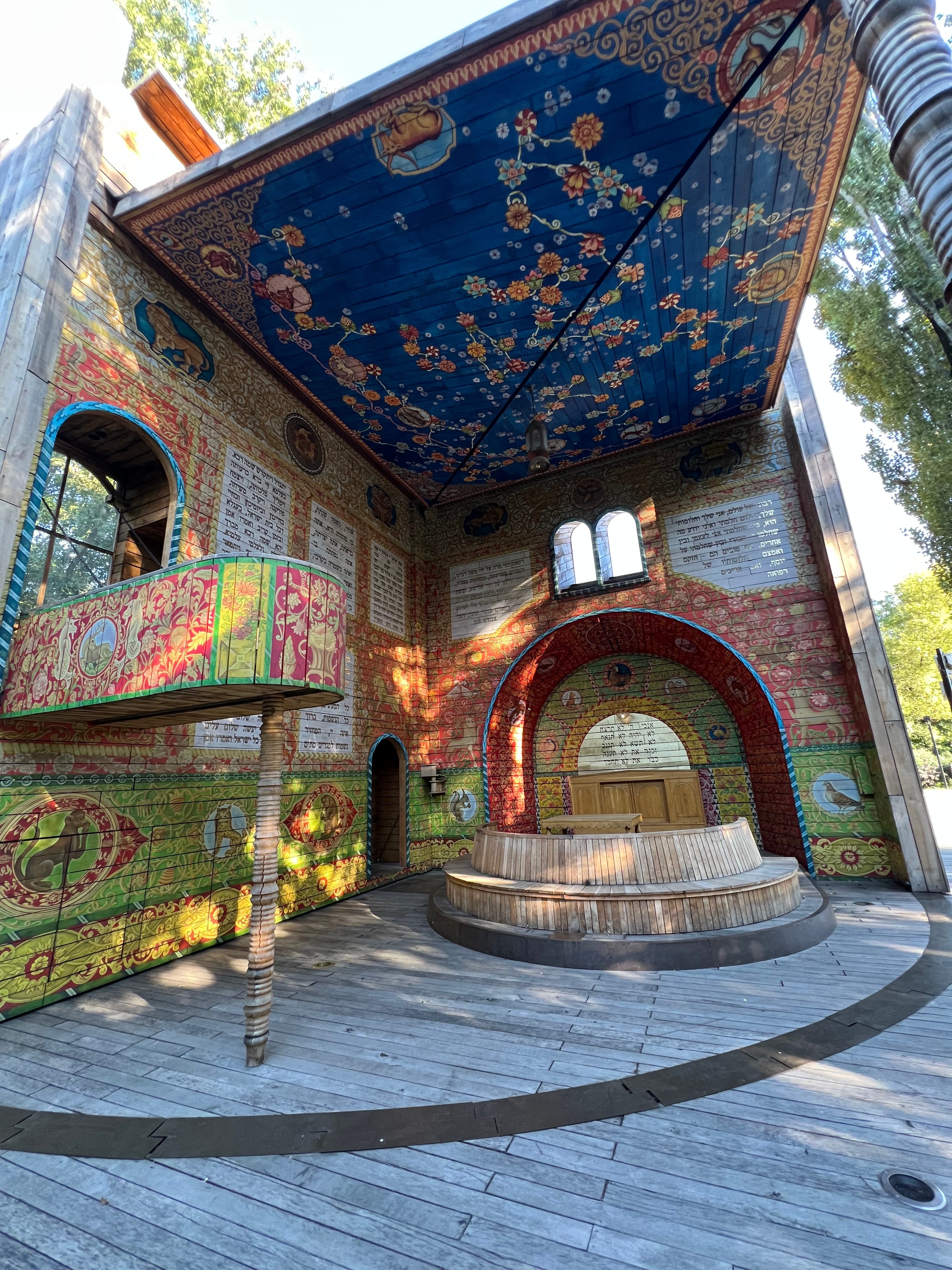
At the far end stands what a marker calls “a place for reflection: a symbolic synagogue.”
The walls are alive with color: deep reds, blues, and golds, hand-painted with animals, flowers, and script. Hebrew prayers cover the surfaces, written as if still being spoken aloud.
After the austerity of the grounds, the synagogue feels almost disorienting, restorative in its beauty. My childhood friend Evan Shatz tells me his family is originally from Ukraine. My cousin Don Shapiro claims similar ancestry from one side. I ask for names and say Kaddish before leaving.
Max Sings the Blues
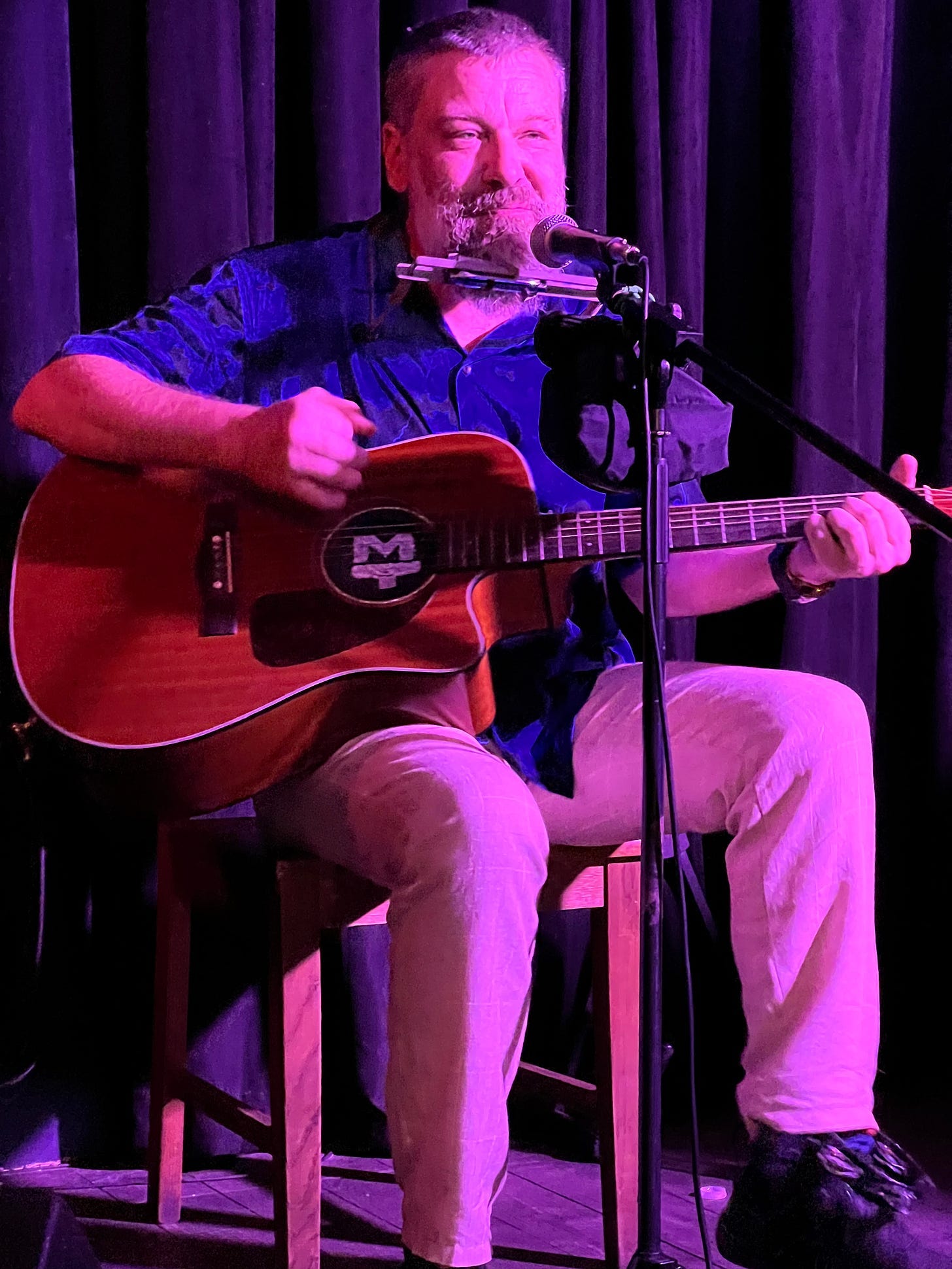
We left Babyn Yar in near silence. A short time later, we would be in Gonzo Craft Beer, music playing, drinks flowing, a different kind of gathering. Kyiv holds both at once—memory and motion, grief and life continuing. We meet up with that night’s performer, Max Tavrichesky. I warn him I may take the stage with him for a song. He insists on it. We record a video chat outside the club, backdropped by bombed-out buildings. Our conversation is punctuated by air raid sirens, ignored by Max, who performs and creates as an act of resistance.
Inside, he puts on a one-man show. Alex brings wife Natalia and their spectacularly cute young son. The kid has a ball, out with well-lubricated grownups. These days, Natalia declares, a Kyiv mother doesn’t get out to concerts much. The family is having a grand time. Vasylyna, the young woman who came along as interpreter, joins us. During a break, Max hands me his guitar, and I perform Lead Belly’s version of “Midnight Special.” Max joins in on his harmonica.
Here’s our conversation outside Gonzo.
Brian Gruber: Max, how did you get into the blues?
Max Tavrichesky: For me, blues came first on the road. I had never been a listener to the blues, never a collector. Already was collecting records when I was a teen, but never blues. But when I got older and hit the road, I understood that’s the music for the road.
Brian: Who are your favorite artists and who and what are you going to perform tonight?
Max: I like a lot of blues artists, all the blues legends. I perform tributes to them. I can make a tribute to Little Walter, and same for Muddy Waters, same for Howlin’ Wolf, same for Willie Dixon. But I also love, they call them small names, like Bubba Barnes, Peg Leg, like Charlie Sayles, like Lazy Lester. They’ve never been international stars, but I still love them.
Brian: Is there anything different in playing and performing or creating music during a period of wartime like this?
Max: For these three and a half years, actually from 2014, it became so routine to me that I don’t even realize the difference. I could say the only difference, when you’re doing it in wartime, you are more devoted to what you do for both listeners and soldiers. Every concert, we would try to raise money, some small money, some big money. It’s not for fun only, yes, it’s to unite people, to make them cool, to reload them.
Brian: In talking to other musicians and artists, I got the sense that for some it’s a political act to go on with a sense of normalcy, to live your life and to create, even though the country is under attack.
Max: I’m just on my way, and I will do that until I die, no matter war or anything else.
Brian: You just came from Kherson. What’s the scene there now?
Max: It’s suffering. Half of the city is destroyed. And they keep on destroying it, just three kilometers distance from Russians across the river, so they reach the town with any weapon they want.
They intentionally target civilians. It’s routine. While we’re talking, there might be two or three civilians wounded by drones. Two to three hundred drones a day over Kherson, some of them are investigating or, when they’re on low battery, the FPV drones hit anything they see that’s closest. A car or a babushka, you know, old woman, or child or shop. They come inside of the shop, explore, exploding everything there.
It’s just terror. Just terror. It’s nothing to do with military action, just terror.
Brian: What’s your hope for the future? What do you think is a good outcome or the right outcome for this war?
Max: It’s hard to say because every day we are used to living like it’s the last day, we don’t know if tomorrow is happening. So, it’s hard to say anything about the future. I know one thing now, there is a battle. It’s not only the battle between Ukraine and Russia. It’s a global battle between good and bad, between sane people and idiots. They’re united, you know? And this kind of global thing makes the future darker. But I am taught by my music that there is always hope in every note, in every sound. I will do that even without electricity.
Earlier in the day, I had been speaking with a journalist about propaganda and truth. In the afternoon, I sat with a man who survived forty-four days of captivity. By evening, we walked Babyn Yar. And later, we were in a bar listening to blues.
A long day, one conversation at a time.
• • •
Additional chapters and forthcoming PDF and print editions of Stop Stealing the Future can be found in the Substack series archive.