
Day 17: Dnipro
Stop Stealing the Future: Chronicles of the Ukrainian Resistance”

“Stop Stealing the Future: Chronicles of the Ukrainian Resistance” is a series of interviews and field observations recorded during travels across Ukraine during the Russian invasion.
The Lovebirds
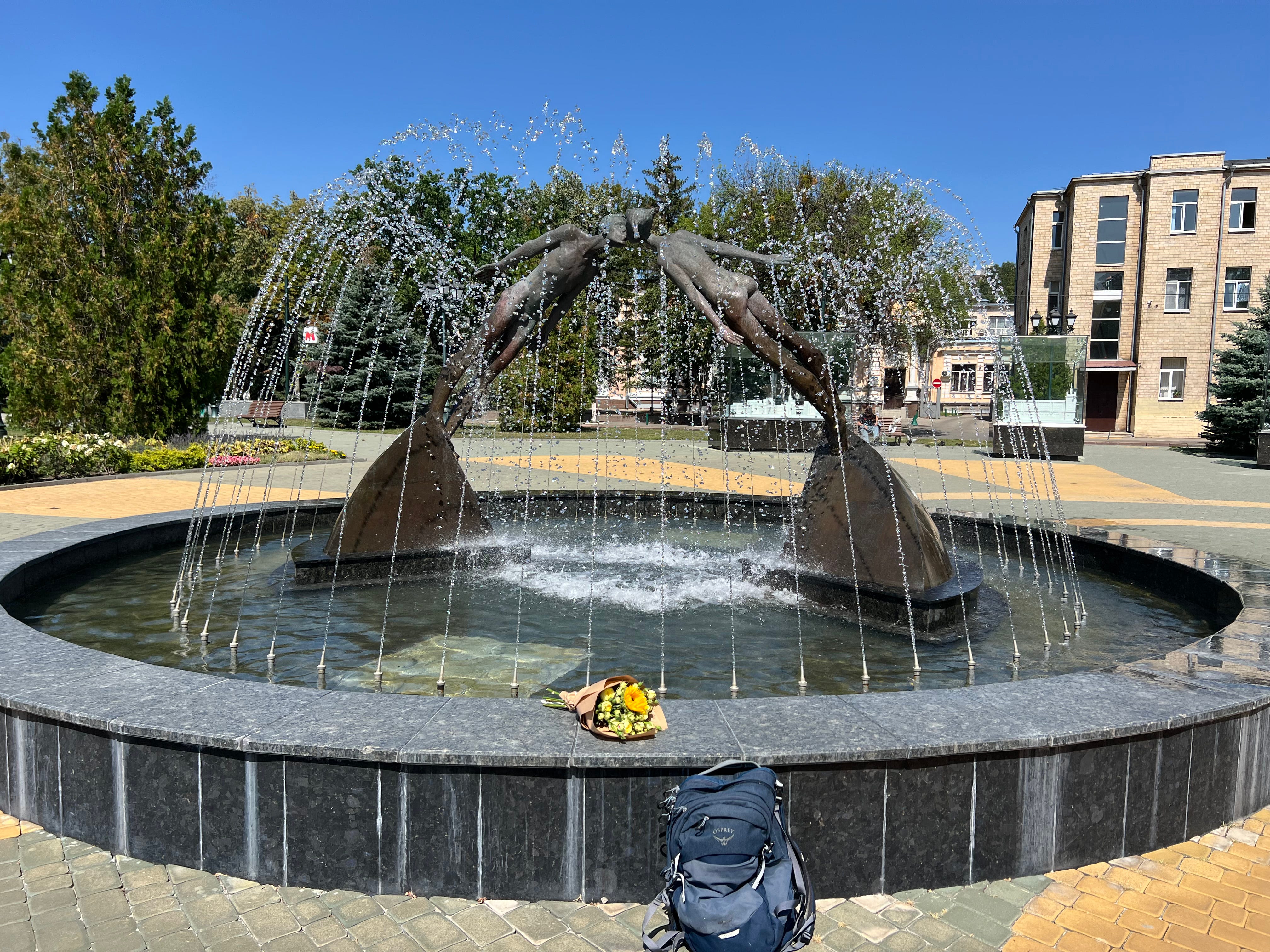
I board the bus for Dnipro, but first, a final visit to Kharkiv’s Lovebirds.
In each city, I find small spaces of serenity. In Lviv, the city center’s outdoor cafés; in Kyiv, the quiet solemnity of the Maidan; in Poltava, the hilltop views of the countryside. In Kharkiv, it’s the Lovebirds.
Just past the once-bombed, now bustling Nikolsky Mall, and beyond the leafy Peremohy Garden Square fronting the aptly named Church of the Holy Myrrh-Bearing Women, stands a bronze sculpture. Two slender figures—a young boy and girl—lean toward each other, meeting in a tender kiss. It was designed by Dmytro Ivanchenko, winner of a 2002 competition for architectural students. The assignment: create a unique monument dedicated to love.
I stop at a florist on the way and ask for a bouquet of yellow flowers, then place it at the fountain circling the sculpture. I sit for a while, watching mothers play with their children, then head to the bus depot.
A Stroll Through Rocket City
Dnipro was known as “Rocket City” during the Cold War. As a center of Soviet military, nuclear, and space industries, it was closed to outsiders until the 1990s due to its role in manufacturing intercontinental ballistic missiles (ICBMs) and satellite launch vehicles.
The Dnipro River is the fourth largest in Europe, stretching some 2,200 kilometers from Russia through Belarus, then south through Kyiv and Dnipro to the Black Sea. My first encounter with it came in Kyiv, walking up the Andriyivskyy Descent with Bucha film producer and longtime Zelensky television writer Oleksandr Shchur. After checking into my hotel, with a few hours before my next interview, I head out for a walk along the river.
There are Soviet-era monuments throughout the country. Some, honoring World War II bravery and resistance, remain. Others—like the Peter the Great statue in front of the Poltava museum—have been removed. Here, a plaque honors Soviet engineering and pontoon units who crossed the Dnipro during the 1943 liberation.
Further along the embankment stands Youth of the Dnipro, a bronze sculpture by Petro Kutsenko depicting three young women in traditional dress aboard a boat, releasing flower wreaths onto the river. Nearby, a chubby, childlike figure from Slavic folklore—Kolobok in Love—sits on a bench covered in “love locks,” padlocks left by couples as tokens of devotion. Another bench features playful cartoon animal figures.
I try to sit on one of the inviting bean bags scattered across the grass to take in the sun and watch the river, but a young attendant insists on a rental fee. My lack of Ukrainian short-circuits the negotiation, and I move on.
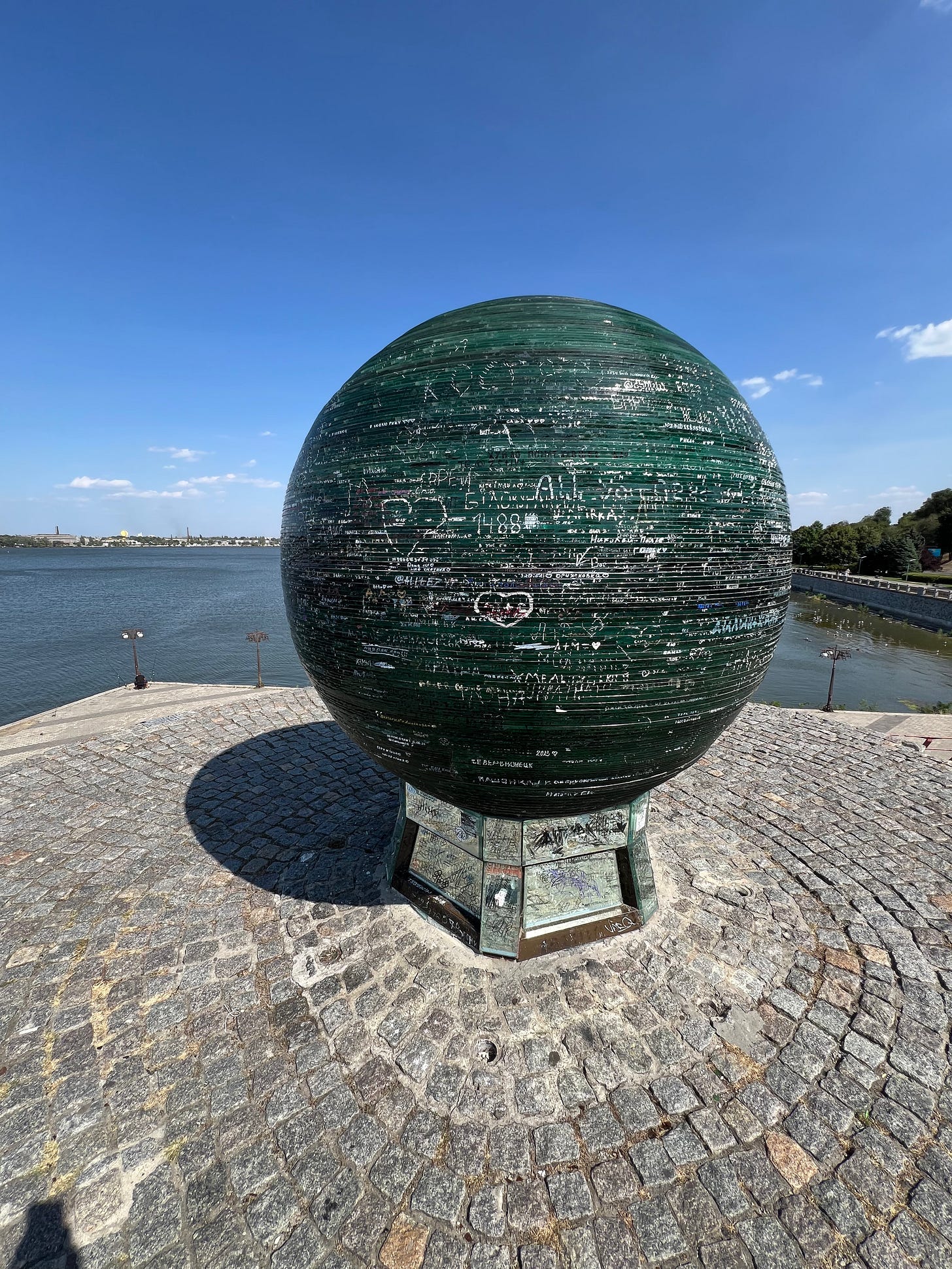
A short set of stairs leads up to a large green sphere, its surface covered in layers of handwritten messages—terms of endearment, phone numbers, names, declarations, inside jokes.
YOU MUSTN’T BE AFRAID TO DREAM A LITTLE BIT BIGGER, DARLING.
Bulldozer
I meet the Bulldozer team through a chain of introductions. Nigel, a British journalist, is an active supporter and volunteer. He arranges the meeting through a series of exchanges—a small example of the broader network of people, Ukrainian and foreign, who have found ways to contribute.
We meet at Varburger, a popular burger joint with an outdoor patio that screens films and regularly supports Bulldozer.
In Ukraine, when a soldier is killed, the military code is “200.” Evacuation 200—sometimes called “On the Shield”—refers to the act of bringing fallen soldiers home. It requires refrigerated vehicles, coordination, and a willingness to enter places most people would avoid. Families cannot do this themselves, and while the Ukrainian military does its best, the need exceeds its capacity.
Bulldozer is one of the volunteer groups that fills the gap. It was started by Serhii’s father. Oleg, one of the principal drivers, joins us.
“Bulldozer is a civilian humanitarian organization,” he explains. “We are volunteers—there are no salaries. Our main work is connected to fallen soldiers. Sometimes we assist in locating bodies, but primarily we transport fallen soldiers from the front line back to their homes, so their families can bury them properly. We also help families with documents—what to do, who to call, how to move through the process—so things don’t take longer than they already must.”
I asked how unusual this kind of work was, and how it had started.
“Yes. It’s unusual—and very difficult. Mentally and physically. We drive enormous distances—right now around 60,000 kilometers per month.”
The origin of the work went back before the full-scale invasion, to his father, Oleksandr—call sign “Bulldozer.”
“He began this work during his military service in 2015–2016. He was assigned to evacuation.”
It was dangerous work.
“He was one of the few people who could cross the front line—even into occupied territory—to retrieve bodies.”
After leaving the military, his father continued on his own. Eventually, the work required something more formal.
“A civilian driving a refrigerated vehicle across the line needed legal structure. So, he formalized Bulldozer as an organization.”
When the full-scale invasion began, that structure became essential.
“On February 24, 2022, everything changed,” Serhii said.
His father had been on his way to do something else entirely.
“He went to return a refrigerated vehicle to his employer, but the owner told him: If you need it for evacuation, take it.”
In those first days, nothing was organized.
“At first, nobody even knew how to respond. The system was overwhelmed.”
Then the calls started.
“Within days, he was told to go to Sumy region and begin evacuations.”
There was a moment where he could have chosen a different path.
“He was standing in line to receive a weapon to join territorial defense. But they told him: We need you more doing this.”
He left the line.
“And he never stopped.”
I asked Serhii and Oleg whether they were alone in doing this work.
“No. The military has its own system, and other groups exist.”
But in the early months, that system wasn’t enough.
“The scale of death was overwhelming. The number of fallen in those first months was comparable to the entire period from 2014 to 2022.”
The infrastructure hadn’t caught up.
“Transport, morgues—it wasn’t ready. That’s where volunteers like Bulldozer became essential.”
I asked how they funded it.
“Mostly through donations and partnerships. My father’s military salary goes directly into the organization.”
Support came in fragments.
“Businesses help. Some provide fuel cards. Others provide tires, repairs.”
Everything went back into the work.
“Fuel, maintenance, repairs. Nothing else.”
And the drivers?
He gave a small shrug.
“All volunteers. We have around 12 to 14 vehicles now, but no salaries.”
Occasionally, something would come through.
“Sometimes donors give money specifically for drivers, and we share it. But normally—no pay.”
The cost, even without salaries, was substantial.
“It can be 350,000 to 500,000 hryvnia per month.”
They were in contact with families at the worst possible moment. I wanted to understand, did the families of the fallen want the war to end at any cost—or continue in honor of those who had died?
“It depends on the person—but mostly, people believe we must continue.”
There was one thing he had never heard.
“I have never heard a family say, ‘Give everything to Russia just to stop. Because then the sacrifice of their loved one would be for nothing.’”
Grief took many forms.
“There is anger. Sometimes people lose faith—even in God. But not the belief that Ukraine must continue.”
Oleg added something through Serhii.
“A mother once looked at a military official and said: My son is dead. Why are you still alive? Why are you not fighting?”
I asked Serhii about the people doing this work.
“One of our drivers fought for ten years, from 2014. Now he’s wounded—he can’t return to the front. So, he drives with us.”
There was a pattern to it.
“Everyone finds a way to continue.”
Serhii continued on the matter of continuing the fight.
“Because if we stop on those terms, it doesn’t end.”
He spoke about what would follow.
“If territories are given up, Russia will recruit men there—force them to fight. Then they will come again. We’ve seen this before. Russia does not understand negotiation. Only force. If we stop without victory, it will be worse in three or four years.”
Oleg offered a slightly different perspective.
“Maybe there could be a pause—a freeze—with guarantees. No recognition of occupied territories. Just a stop.”
A possibility, however uncertain.
“Maybe leadership in Russia changes. Maybe then something else becomes possible.”
Serhii didn’t sound convinced.
“History doesn’t give much reason for optimism. We’ve seen this before—in Europe, before World War II. Territories given away to avoid conflict. It didn’t stop anything.”
And the implication extended beyond Ukraine.
“If Russia is not defeated, others will be next. Ukraine has enough support not to lose—but not enough to win. That is the problem.”
The Vodka and Dance Sacraments
I have a few hours before my overnight train departs for Odesa. There is time for one tourist destination, so I head to the Menorah Center, claimed in various promotional statements to be the largest Jewish community center of its kind in the world. Big claim.
I wander around, perplexed that there’s no one to welcome or guide visitors. I approach an officious-looking desk, and the clerk apologizes and promises a tour guide if I can wait a half hour. Sure. Down the hall is the aptly named Hummus Bar with comfortable seats and, well, the hummus is pretty good, and so is the red wine.
A friendly young fellow, Mikhail, arrives and off we go through an extended tour of the facilities. There is a massive meeting room with piles of supplies; apparently, a big dinner is planned after Friday’s Shabbos prayers in the historic Golden Rose synagogue. We head up to the roof for a panoramic view of the city, where he shares favorite tourist tales and we talk about the war. I ask if I can visit the synagogue and he escorts me downstairs.
As we enter, a bearded fellow kisses the mezuzah on the door. I spent my childhood wearing a mezuzah necklace, a tiny scroll of Torah verses inside. As a show of respect, I kiss my fingers and reach to touch the mezuzah as well.
“You a Jew?” he asks.
Well, yes, I am.
Suddenly, the dynamic shifts and he pulls me to the back of this glorious house of worship and asks if I have had tefillin lately—a religious practice of applying small black leather boxes with leather straps to the arm and forehead. I mention the last time, years earlier, living in a yoga shala on a Cambodian beach run by an Israeli couple, where I tracked down a bottle of kosher wine through a Chabad rabbi in Phnom Penh to pull off a makeshift Passover seder.
Rabbi Milman has me read daily prayers as he wraps my arm. I study the verses as I speak them. Some are lyrical and inspiring; others, theologically, not quite my lane. This is, after all, an Orthodox house, and in one passage I thank God that I was not born a woman, a gentile, or a slave.
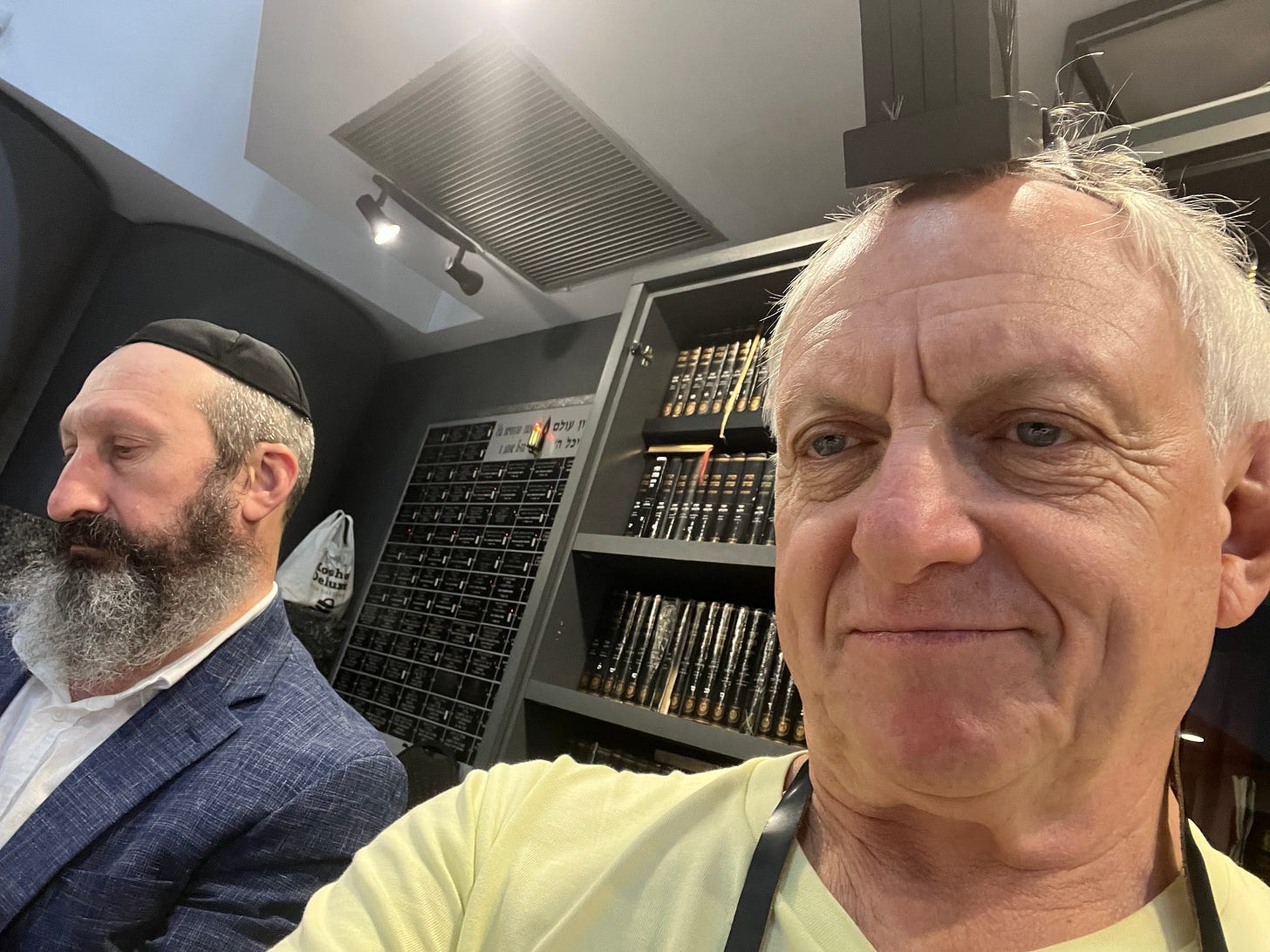
Rabbi Milman tells me that the Chief Rabbi of Israel and the Minister of Religious Services are joining the congregation for Shabbos services and a big community dinner and invites me to come as their guest. Two thoughts immediately arise. One: he is making this up. Two senior Israeli officials here tonight? Implausible. And then: I have a train to catch—and I’d better catch it. This is high season for summer travel and the trains are booked solid.
I decline. He insists. I pause.
“OK,” I tell him. “I’ll go to the station and see if I can change my ticket.”
He is pleased.
I take a taxi. It’s hot, and no one speaks English—or at least the station clerk knows enough to say, “no way.” I ask about a bus. She gestures vaguely toward another part of the station. I walk the entire complex, circling through corridors and courtyards, but find nothing. My Google Maps app sends me to an empty parking lot.
At this point, less than two hours before I need to gather my bags and get to the station, I am standing on asphalt, shirt soaked with sweat, insisting to myself that I promised never to do this again—no stressed, last-minute dashes to airport gates or stations or appointments. I have a plan, a ticket, my bags are packed, and there is no way the rabbi is really hosting the Chief Rabbi of Israel. And even if he is, I would have no access.
I call Max, my Ukrainian friend back in Thailand. I’m not sure how late it is there, but I estimate it must be approaching midnight. Can I get a bus tomorrow? He promises to check schedules, then texts back: yes, seats are available. Not as comfortable for the long trip, but available, and he can book me for tomorrow afternoon.
I return to my hotel, grab my bags, check out, and take a taxi to the Menorah Center, where I check in. I shower and make my way to the synagogue just as services are beginning.
On the way, I post a note to friends. I see three ways to approach the evening: ask my sudden acquaintances about Israel’s actions in Gaza, experience the moment as a man of Jewish ancestry, or simply participate, observe, and chronicle it. The advice that comes back is the latter two.
On the stage is a charismatic speaker, preaching in Hebrew with a Ukrainian interpreter. I know neither language, but I am impressed by his warm, exuberant, confident presence. The last time I encountered someone with this kind of evangelical charm was in Kabul, when I spent hours with Dr. Ayaz Niazi, Afghanistan’s leading Islamic scholar and imam of the city’s largest mosque.
I move closer.
At the end of his talk, he and others in the congregation begin to dance in a circle around a raised platform at the center of the room. He smiles as he passes, extends his hand, and pulls me into the circle.
It’s a wild scene—ecstatic, communal, spontaneous.
Moments later, I learn that the man I’m dancing with is indeed Kalman Ber, the Ashkenazi Chief Rabbi of Israel. I notice that the scene is all male, and when I look up, I see the women gathered on the balcony.
Inside the grand ballroom, Rabbi Milman seats me at the guest table next to Sergio, an urbane English speaker who narrates the scene and interprets. We eat well—platters of traditional Jewish and Eastern European food. And drink well. Bottles of vodka are plentiful, and it seems everyone reserves Friday for celebration after a pious week in a country at war.
Gradually, after hours of singing and hugging, the room starts to empty out.
Through the evening, I notice a serious-looking fellow accompanying Chief Rabbi Ber—young, dark-complected, with a close-shaven beard, contrasted with the bushier styles around him. I stand nearby with Milman and the Ukrainian interpreter as he speaks with Minister of Religious Services Michael Malchieli, their conversation moving between Hebrew and Ukrainian. I understand not a word, but the meaning carries.
Whether it’s the uniqueness of the moment, the vodka, or that cookie I ate hours before, I can’t be sure.
I tell Milman I want to ask the Minister about his beard.
“No, no, no,” he says. “Sensitive subject.”
Through the interpreter, I introduce myself and say, “I’ve been watching you tonight. You seem deep in thought most of the time. You have a graceful style about you. And I notice your beard is different from everyone around you. Why is that?”
He laughs and explains—through translation—that Sephardic and Ashkenazi traditions approach such things differently.
Rabbi Milman then mentions that I’ve been to many Muslim countries but never to Israel. The Minister expresses friendly outrage and insists I come as his guest, listing places he would take me with enthusiasm.
As midnight approaches, the large ballroom empties out, leaving a dozen of us seated around a table. Rabbi Ber sits to my right, his knee pressed against mine. Periodically, one of the men jumps up, singing and clapping, drawing others in before the room settles again into conversation and drink.
I don’t understand Hebrew, but the shared ecstasy is real.
The next morning brings more services, more prayer, more food, some more vodka, lots of hugging. I spend time with the Ukrainian interpreter discussing Zelensky, conscription, the path to peace, and how the Jewish community has come together again—after a long history of Russian pogroms, Nazi deportations, and Soviet persecution.
I thank Rabbi Milman, with one eye on my bus schedule.
On my way out, I say goodbye to the Minister. He is mid-conversation, so he raises his thumb and pinky to his ear in the universal phone gesture and mouths the words:
“Call me.”
An hour later, I am on the road to Odesa.
• • •
Additional chapters and forthcoming PDF and print editions of Stop Stealing the Future can be found in the Substack series archive.